Track every turn of the wheel
Track positions, sell puts and calls, roll with confidence, and screen candidates — everything you need to run the wheel strategy in one dashboard.
21 days of everything, no credit card. After that it stays free for up to 3 open positions — nothing is billed, and nothing you logged goes away.

How it works
Three steps, then it keeps up on its own
About thirty seconds to log a position, or one upload for a whole broker history. Nothing to install, no account to link at your broker — and every calculator works before you have an account here at all.
Already been wheeling? Import your history from tastytrade and Schwab.
One CSV export and every cycle is rebuilt from your own fills — puts, assignments, covered calls and roll-ups, with the premium carried through. More brokers are being added; each one ships only after a real export has been read end to end.
See how the import worksLog the trade
Strike, premium, expiry, contracts. Thirty seconds, and it is the last time you type those numbers — or bring a CSV from your broker and have the cycles reconstructed from the fills you already have.
Let the cycle run
Assigned, covered call written, rolled, called away — each one carries the premium forward instead of starting the count again. The card shows where the stock sits against your strike and how long is left, and the calculators answer the two questions it raises: close early, or roll.
See what it paid
Realised profit per finished cycle, a month-by-month journal, and a tax summary that already knows which premium was assigned into a cost basis and which was kept. The number at the end is the one you can actually spend.
What Wheel Folio does
Track every wheel cycle
Log cash-secured puts, assignments, covered calls, and rolls in one place. Wheel Folio carries the cost basis and cumulative premium forward automatically as a position moves through the cycle.
Screen for candidates
Upload a CSV from any screener and every ticker is scored as a wheel candidate — price, market cap, volume, beta, IV rank and trend — straight from the columns in your file. Then score each contract you are considering on annualized return, cushion, days and delta.
Live prices, ITM/OTM/ATM
Every open position shows a live stock price and an at-a-glance assignment-risk badge, so you know what needs attention without pulling up a broker tab.
LEAPS tracking
Log long-dated calls and puts you've bought outright, separate from your wheel cycles, with the same live pricing and an intrinsic-value P&L estimate.
Assignment & expiration alerts
Get notified when a position crosses in-the-money, approaches its strike, or is closing in on expiration — checked automatically while you use the app.
Import your broker history
Upload a tastytrade and Schwab transaction export and Wheel Folio rebuilds the wheel cycles inside it. Your broker's file records four unrelated trades; this is the part that knows they're one cycle, with the premium folded into the share cost basis.
Before you sign up
Is this built for you?
Wheel Folio does one strategy properly rather than every strategy adequately. Here is the honest version of who that suits.
Built for this
- You sell cash-secured puts and covered calls, and want the whole cycle in one record rather than a row per trade
- You get assigned sometimes, and want the put's premium to come off the share cost basis instead of being booked as a separate win
- You roll, and want the premium from the leg you bought back to keep counting toward the cycle
- You want to run the numbers before you sell — return on capital, breakeven, whether closing early beats holding
- You would rather type the trade in yourself than hand a website your broker login
Not built for this
- You want it to place the trades. It never connects to a broker and cannot send an order
- You trade for direction — 0DTE, momentum, earnings punts. This measures cycles, not entries
- You want signals or picks. The screener scores candidates you bring to it; it does not choose them
- You need a live options chain and running Greeks. Delta and IV are recorded at entry, and that is all
Not sure? Look round an example portfolio before making an account.
A look inside
Eight screens, doing their job
Real screenshots of the app running on sample positions. They move on by themselves — stop them, or scroll sideways, whenever you like.
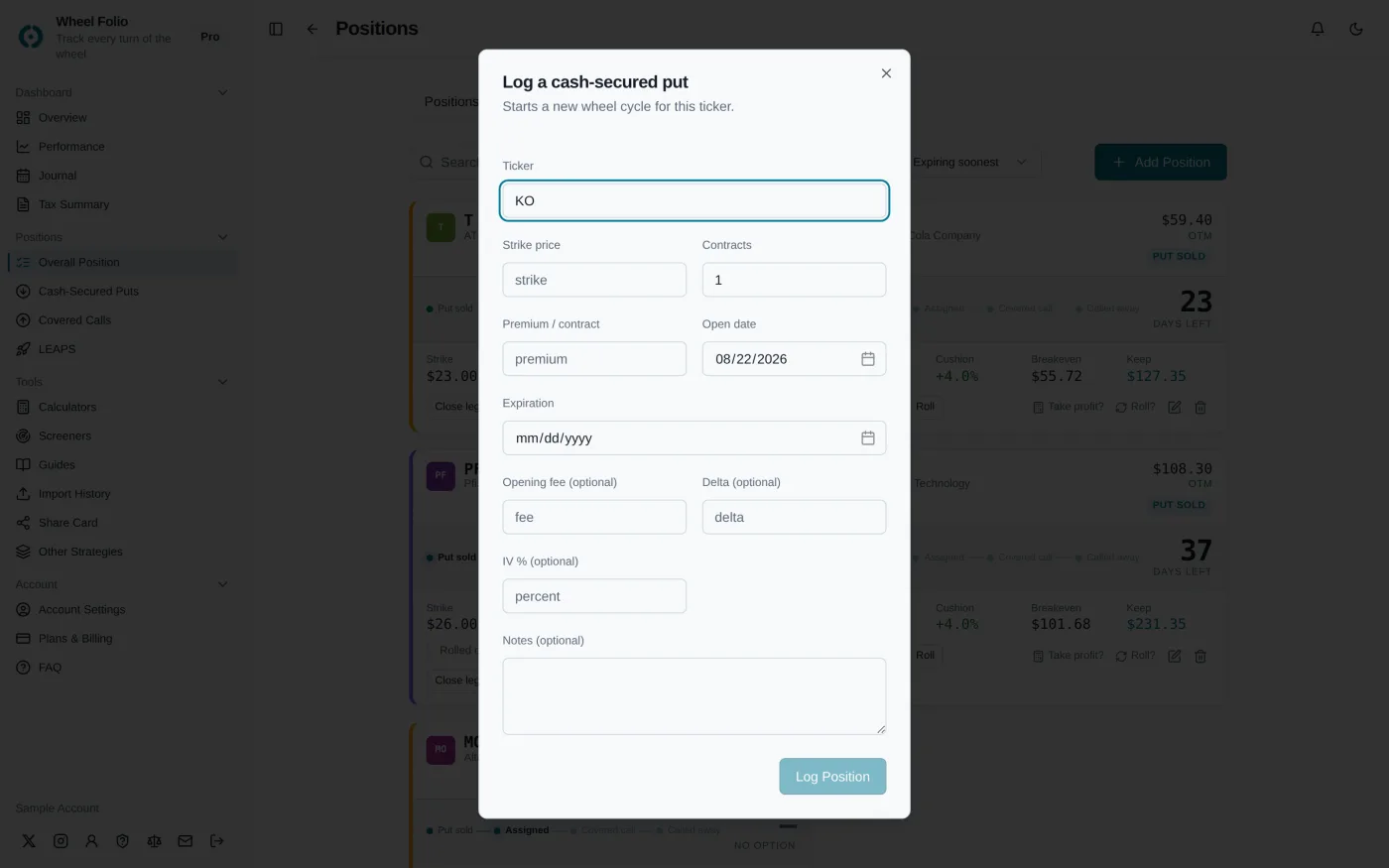
Adding a position, start to finish
One dialog: ticker, strike, premium, expiration. It opens a wheel cycle rather than logging a trade — which is why the assignment, the covered call and every roll after it attach to this one record.
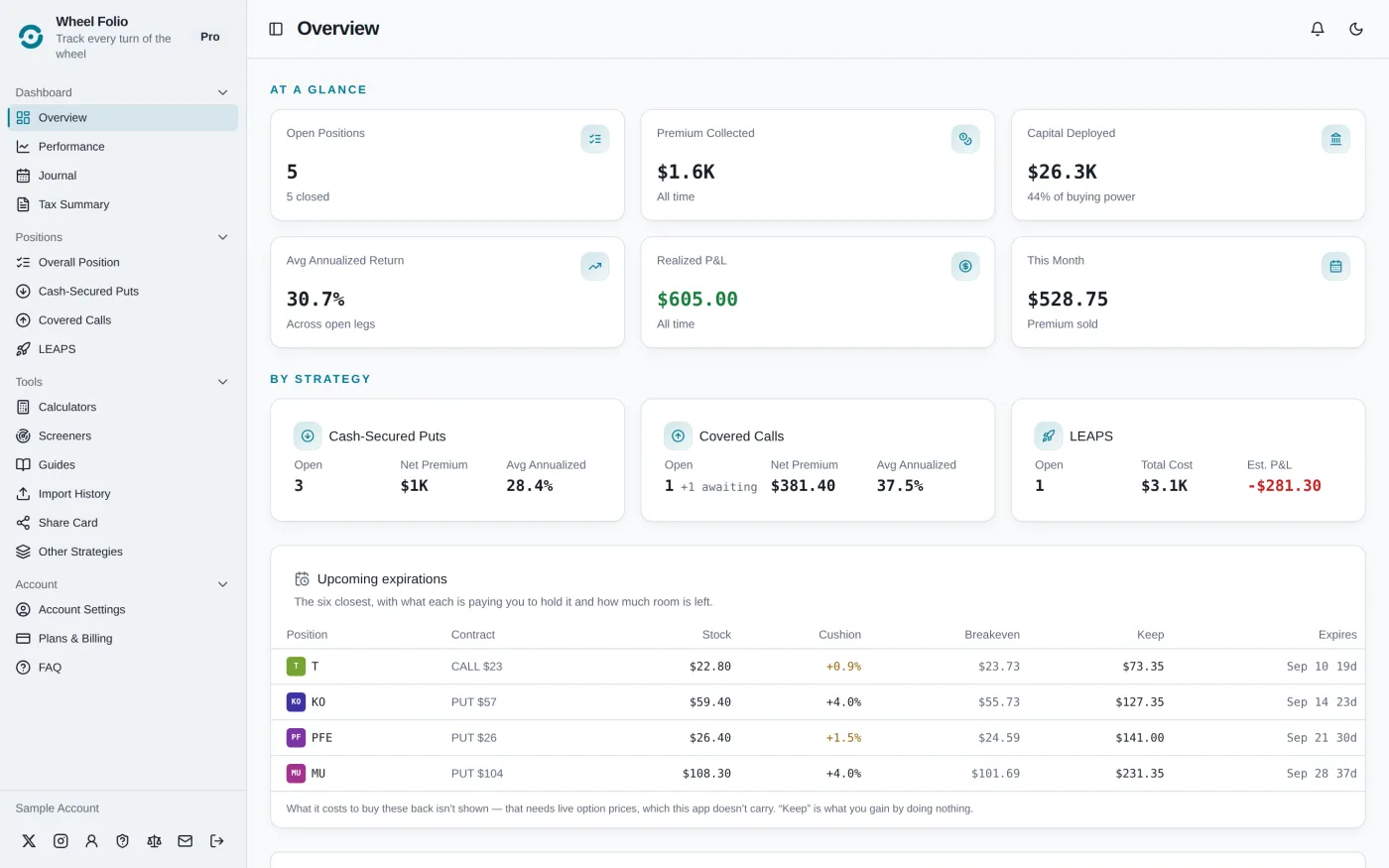
Everything open, and what it has paid
Open positions, premium collected, capital deployed and realised P&L on one screen, with the last six months of income underneath.
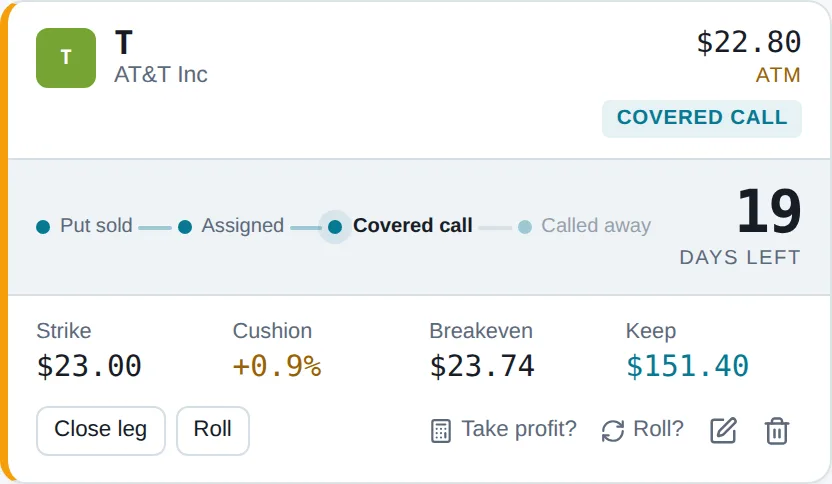
A live price, and how close you are to assignment
Every open leg carries a live quote, an in- or out-of-the-money badge, where it sits in the wheel, and the share cost the premium has already knocked down.
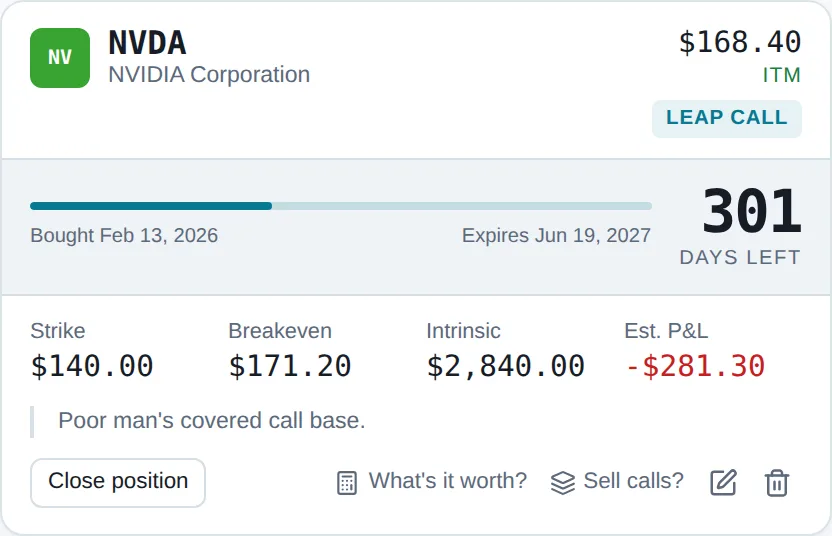
Long-dated calls, on the same card
A LEAP has no wheel to sit on, so the band carries the line it does: bought to expiry, with the part already spent filled in and the countdown beside it.
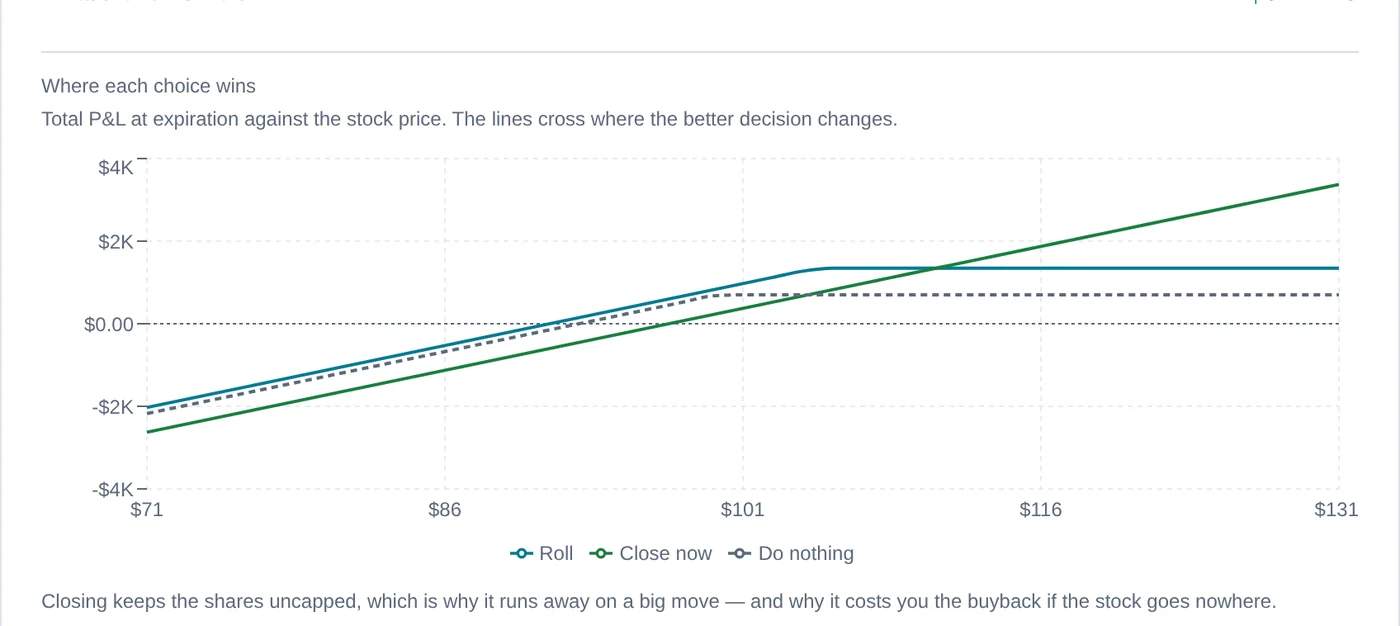
Which choice wins, and at which price
Rolling, closing and doing nothing plotted against the stock price. The lines cross where the better decision changes — the number nobody works out by hand.
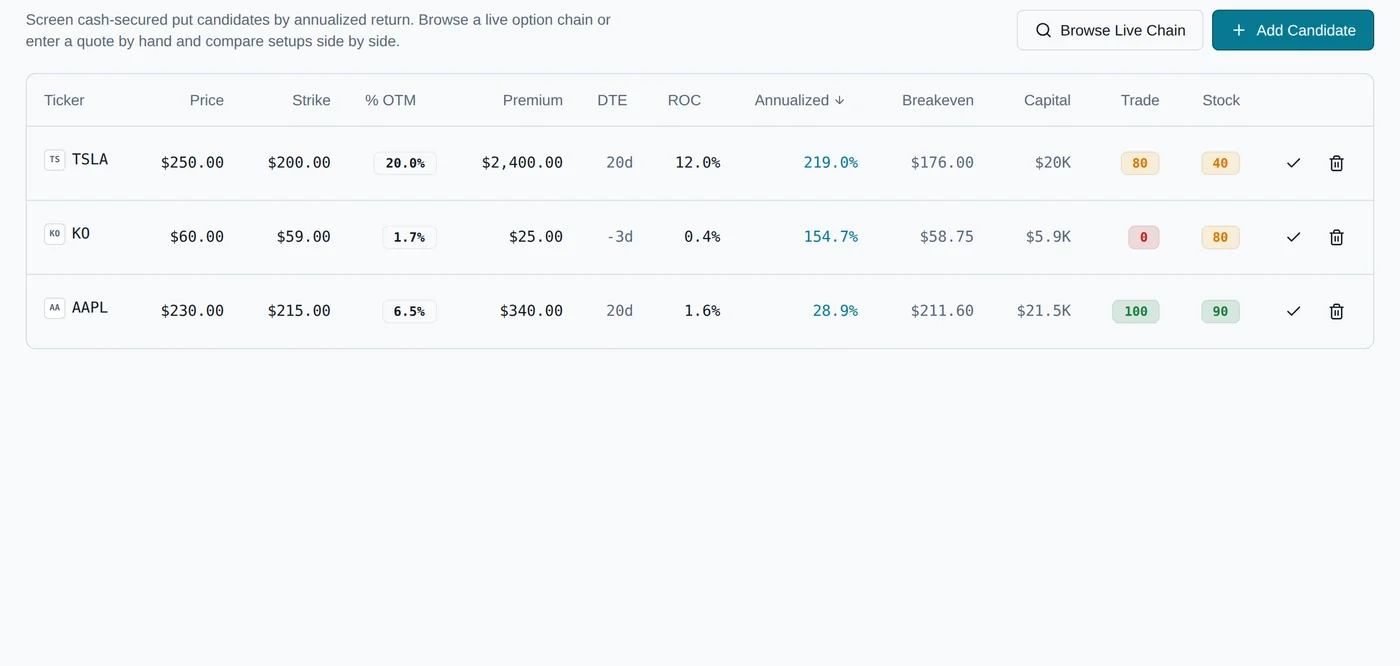
Score candidates before you sell anything
Every candidate scored on the trade itself — annualized return, cushion, days to expiration and delta — so the shortlist sorts itself.
Sample figures. Annualized return is a comparison rate, not a projection — see the calculator for why.
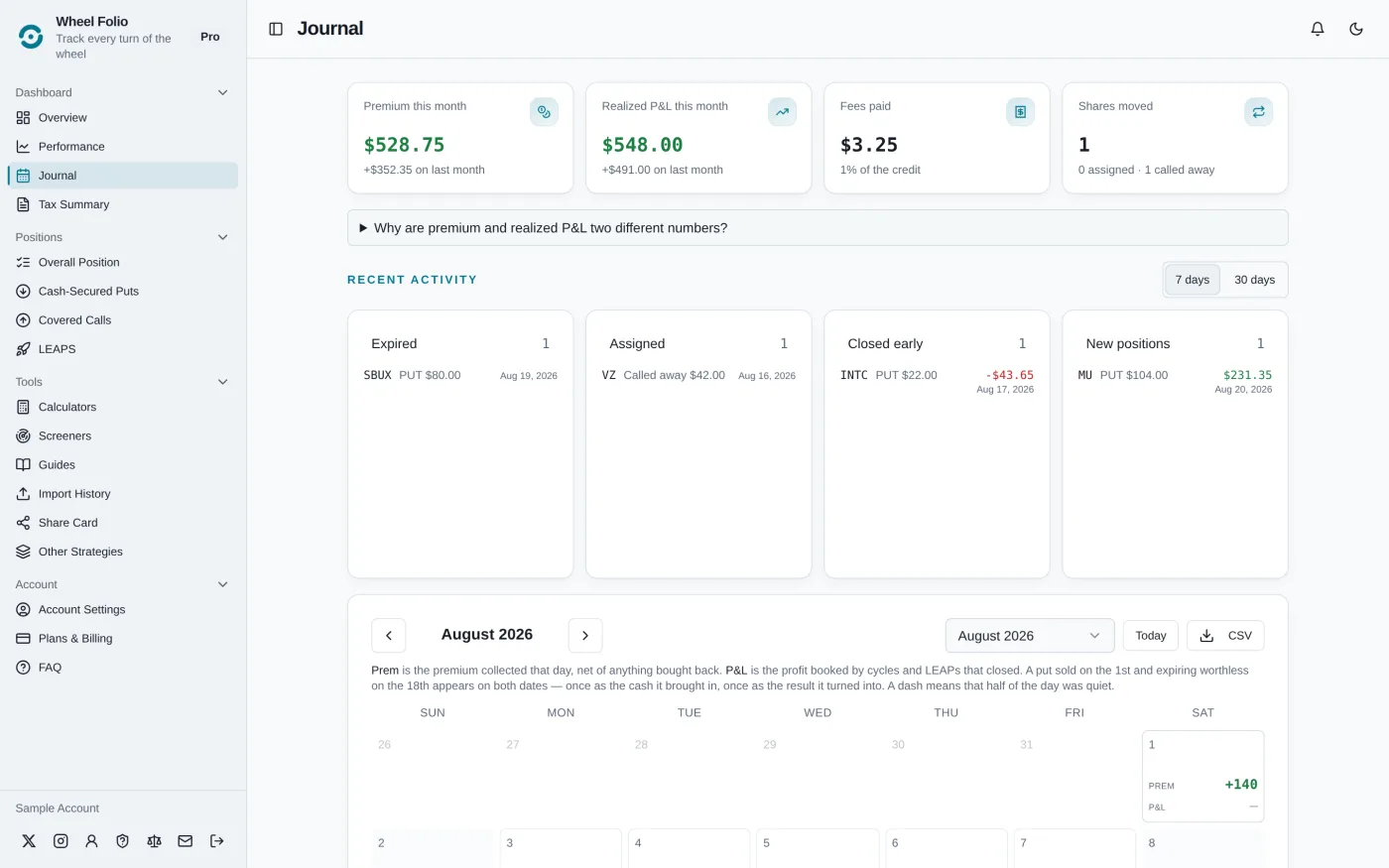
Every day, and what it paid
A month at a glance: premium collected on top of each day, profit booked underneath. Click a day to see the trades behind it.
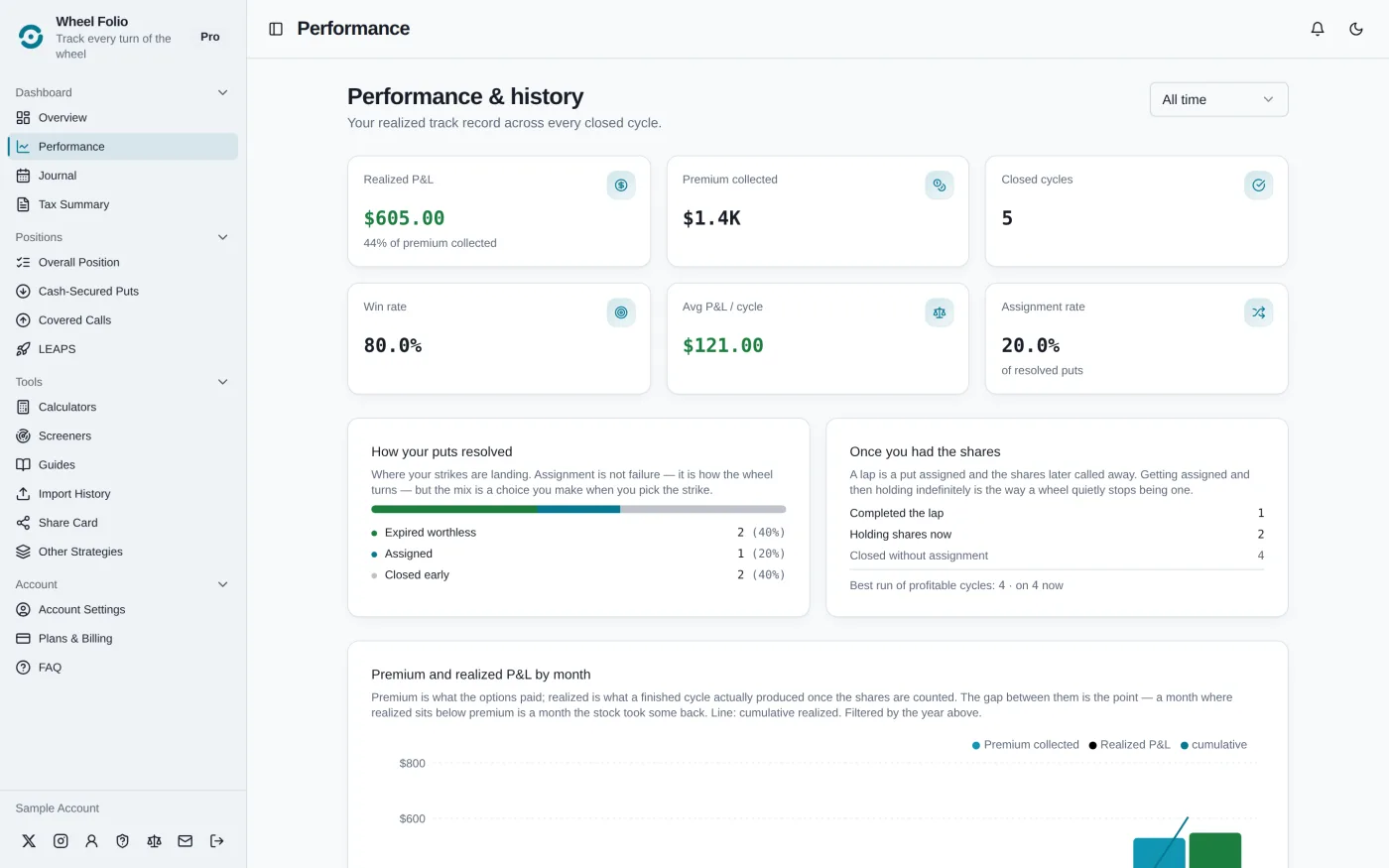
What you have actually made
Realised P&L by month, win rate, assignment rate, your best and worst closed cycles, and which tickers have really paid.
Who built this
A working doctor who runs the wheel
Dr. Jonathan — Family medicine physician. Wheel strategy practitioner, not a financial adviser. I still see patients. That is rather the point: the wheel runs on a monthly cadence, which is a schedule someone with a demanding job can actually keep.
Wheel Folio started as my own spreadsheet. The trackers I was using got the cost basis wrong through an assignment, annualised returns differently from how I would work them out by hand, and none of them understood a wheel cycle as one continuous thing rather than a pile of unrelated trades.
I am also fairly new at this, and I would rather you heard that from me than worked it out later.
What I can tell you is that everything here is what I actually do. The strategies in the guides are the ones I run, the screening criteria in the app are the ones I use on my own positions, and there is no better system held back for a paid tier. There are no returns published on this site, mine or anyone else’s.
Email support reaches me, not a desk or a queue — usually answered within one or two business days. How to get hold of me.
The longer version, including where a medical credential is worth nothing
Your data
What this can reach, and what it cannot
Wheel Folio does not connect to your broker. That costs you automatic syncing, which is a real trade-off — and it is why the list below can be this short.
No broker login, ever
There is no “connect your account” button and there is not going to be. You export a CSV yourself and upload it, or type the trade in. Nothing here holds a credential to your brokerage, so nothing here can leak one.
It cannot place a trade
Not “we choose not to” — there is no trading connection in the product at all. The worst a bug here can do is show you a wrong number. It cannot move your money.
Card details never reach us
Payment runs through a Stripe checkout page. Your card number goes to Stripe and never to this server, so there is nothing here to steal.
Delete it and it is gone
One button in account settings removes every position, leg and import you have logged, and cancels the subscription on the way out. No email to support, no waiting period.
Live prices are looked up by ticker alone — the vendor is asked what KO costs, never who wants to know or how much of it you hold. The privacy policy has the rest.
Pricing
Simple, position-based pricing
Every account starts with 21 days of Pro, no card. Keep it, or fall back to free — both are real options.
Free
Where every account lands when the trial ends. No card, no expiry.
Pro
billed monthly
Everything the tracker does, for one price. Free for your first 21 days.
- 21-day free trial — no card, cancel by doing nothing
- 7-day refund after that, no questions asked
- Unlimited open positions
- Live prices & company info
- Earnings dates
- LEAPS tracking
- Roll & take-profit calculators
- Assignment & expiration alerts
- Broker history import (tastytrade, more to come)
- Tax summary with per-cycle events & wash-sale flags
- Full CSV export
- Priority support
Full refund within 7 days, no questions asked. Subscribe already and your rate never changes — a price rise only ever applies to new subscriptions. Both are in the Terms.
Questions about plans, your data, or whether it connects to your broker? The FAQ answers them — it doesn't, and never will.
Guides
Learn the strategy
Free, no signup — the wheel end to end, plus the structures around it.
Long-dated positions
The mechanics underneath
Other options strategies
Calculators
Run the numbers first
Free, no signup. Return on capital, annualized yield and breakeven before you open — then the harder ones: whether closing early actually beats holding, and what a roll really nets once you've paid for the buyback.
Cash-Secured Put Calculator
Collateral, return on capital, annualized yield and breakeven for a put you're thinking about selling.
Covered Call Calculator
Premium yield, what you make if the shares get called away, and where your basis actually sits.
LEAPS Calculator
Breakeven, how much capital a long-dated call saves against shares, and what you're paying for time.
Poor Man's Covered Call Calculator
Net debit, strike width, and whether the setup clears the one rule that decides if a PMCC can work.
CSP Take-Profit Calculator
Whether closing at 25/50/75% actually beats holding — and the last day it still does.
Covered Call Take-Profit Calculator
Whether buying the call back early beats holding — and the last day it still does.
Covered Call Roll Calculator
What a roll really nets after the buyback — and whether the new strike still clears your basis.
Cash-Secured Put Roll Calculator
What rolling a put down and out nets — and what assignment would actually cost you.
We’d like to use Reddit’s advertising pixel to see which of our Reddit ads bring people here. It sets third-party cookies. Everything else on the site works either way — our own visit counter uses no cookies at all and is not affected by this choice. Privacy Policy.